2 April 2016

Wireframing is fun!

Even though I haven't done any real training on it I really like wireframing. I liked reading through Google's Material Design principles and figuring out which user interactions would make the most sense.

I wireframe things for fun all the time - it helps me think about the composition and the parts of what I'm doing - but this was my first time using an editor to make it look neat.

I used NinjaMock because I'd heard of it before and it's free for personal use. It took a little getting used to though. At one point I lost all my work because I wanted to add my own assets and then found out you needed an account to add your own assets. But once I was faced with a blank screen again it was very easy to recreate what I had before now that I knew where to go for what I wanted (only having 3 views helps).

I think there was a way to show the interactions using NinjaMock but that was beyond what I needed - I just wanted to show people something that wasn't my notebook.

Original thought process and sketching

View 0 - Home screen

View 1 - Slightly different from the way I sketched it because I talked through the data-structure with the data architect

View 2 - I'm a little worried I'll create something that doesn't work but has really awesome animations


23 March 2016

Basics of social media

Koro Sensei isn't around right now - so you have to learn from me!
I helped put together a presentation introducing other campaign groups to social media. I've removed all TaxPayers' Alliance stats and replaced them with my own, as well as cut down on the number of slides - deleting half of the example slides and the 'how to access these tools' slides.
If you can't see the deck below you can find my SlideShare here. This is the first time I've used SlideShare so let me know if I've done something odd.

9 November 2015

Redcar doesn’t want to lose jobs - but neither does China

Blog for The TaxPayers' Alliance! I've copied the first part here but you can find the full blog here and it was also published in the Yorkshire post here!

------------------------------------

First Redcar and then Tata Steel announced further job cuts in the steel industry. Exactly what is going on and is there a case for the government to intervene using taxpayer cash to prop up the current price of steel or bail out the suffering plants to protect British jobs?

The Steel Industry in the UK

A large motivating factor in the outcry is that the jobs under threat are of national historic importance to the country. During the industrial revolution producing steel was of national importance in order to grow the railways, build machinery and expand.

By 1870 Britain produced 60 times more steel than it had in 1800 and in 1875 Britain produced 40 per cent of the world’s steel. But by 1896, only 20 years later, Britain’s share in the world steel market dropped to 20 per cent. The industrial expansion slowed and so did production of steel.

Then in the post war period the steel industry went through a lot of uncertainty as successive governments nationalised, privatised and re-nationalised the industry. Conflicted objectives and a lack of innovation meant the industry wasn’t free to develop and grow as it liked due to the uncertain climate.

Steel production volume continued to fall and so did exports. Currently Germany ranks 7th in the world for total output, making it the biggest producer in the EU, with Britain ranking as 18th.


2 July 2015

Writing a blog post


So, here's another very quick guide that I wrote for the TPA to accompany my SEO one. Again, I'm not actually an expert by any stretch of the imagination so if you actually want to learn about these things I suggest you use Google. However, here's some basic things that you should keep in mind when writing a blog.


Hey guys, a lot of you seem unsure about how to write a blog? Or your blogs seem more like essays than blogs so here are some general things to keep in mind

Writing a blog with Yui from K-On!


Audience and purpose: Always keep your audience in mind. How much do they know about the subject? If you're unsure, assume an intelligent reader with no prior knowledge of the subject at hand. That means explaining any acronyms, using shorter, clearer sentences and telling a story rather than presenting an argument.

Tone: Conversational and simple. As if you were explaining a concept to a friend of a friend.

Content: Again, keep it simple but interesting. Don't get bogged down by the nuances of the story. Link to a source on another site if you need to. As a guideline length should be around 500 -750 words.

Images: Only use them if they contribute something to the experience of the reader rather than from decoration. In this case centre them on a new line rather than wrapping the text around the image. Make sure you give a detailed descriptions in the image tag.

Example: I quite like Mana's blogs Manchester's £3.5 million black blob of glass and Taxpayers to pay hundreds... so Councillors can learn how to run the Council.

30 May 2015

Cool things I found this month

Unfortunately, I feel like I haven't improved over the past month.... So here are some cool things that I learnt and links that I found instead.

How to commit electoral fraud

I voted in the election this month but I didn't have my polling card and they didn't ask for any ID either. When my mother went to vote with hers they said she had already voted but I hadn't. So there you are, if you want to commit electoral fraud at any point in your life it's very, very simple. You can also just take someone else's polling card and use that. Again, you don't need ID.

Various links

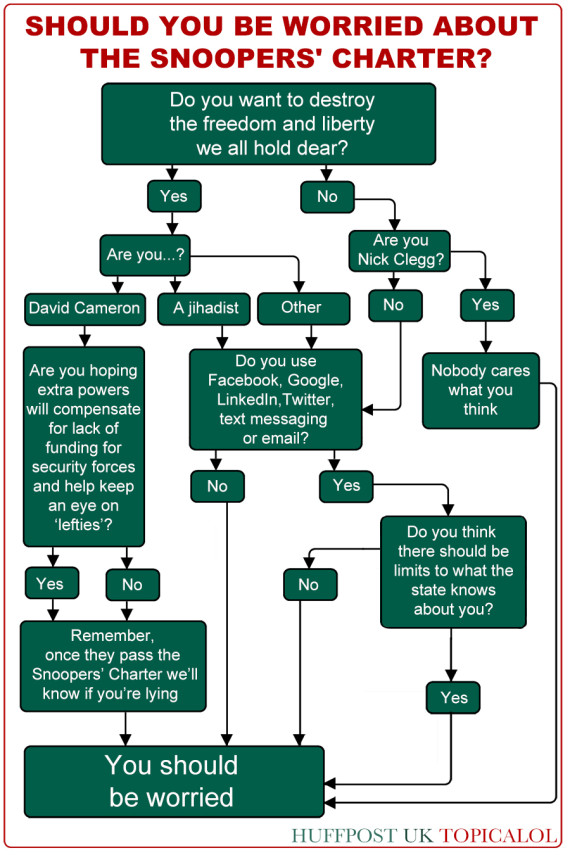
The Snoopers Charter


Video: secure messaging and credible news


If you worry about the security of your messages, try Bleep. It even gets around how people can just screen grab the conversation. You don't need to sign up with an e-mail and the chat is secured. Seriously! It's pretty cool!


Did you know that eating chocolate helps you loose weight? Thank's to a study in Germany we can now eat chocolate and stay healthy! Or can we? As this long article details you can't trust every new study that comes out. I like to think of this as the next dihydrogen monoxide scandal. I bet you'll see people quoting this study for years to come. Thankfully, the internet is forcing us to be sceptical about what we see online and the iO9 article notes that many of those that commented on these 'news stories' asked the questions that the journalists in question should have asked themselves.

The video above is kinda related, it was commissioned by a Brazilian news company to demonstrate why you should get your news from a reputable source. Interesting video and great artwork.

Inspired by the... Sky?

I took some photos of the sky! My finance got in the way. He's pretty cool though so it's okay.


28 May 2015

Jordan's really short guide to blog optimisation

This is literally an email I sent around a while ago which I have since forwarded to so many people that I'm preserving it for reference. What follows is a copy and paste dump that has only been edited very slightly.

This also only pertains to writing. If you're writing your own blog then you'll need to think about many other things. Here's a good short guide from Moz on those other things.


Here's a quick guide to why it's nearly perfect. Don't worry about this for short blogs, but if you're writing something substantial you might want to keep these in mind.


Reasons why it's perfect / Jordan's quick guide to blog optimisation:

Long form: Over 1000 words means its less likely to be ranked as spam

Keywords: E.g Tax, Spending Plan are repeated

Related words: (If you're writing well, you shouldn't have to think about this) You can't just write keywords like tax, tax, tax in every sentence. Google and Bing now use 'context words'. It differentiates between people complaining about high taxes and accountancy websites by checking for context. If this blog also contained words such as 'efficiency' 'accounts' 'money' 'future' it would rank poorly for a someone googling 'conservative government tax policy' for example.

Headings: Like in essays, used to break up text (good for readers) and the words in headers are given more 'weight' by search engines. Here we have headings with keywords in them double points.

Links: Make sure your 'anchor text' (ie the text attached to the link) is attached to keywords or descriptive words. "Click this link" "You can find the full article here" and "For example" are all examples of bad anchor text.

Bold: Bold your key words and phrases. Someone should be able to read only the bolded parts of the article and understand the key points of an article.

Pictures: People like pictures. Google likes pictures with long titles. Graphs count as pictures by the way.

3 May 2015

May: What I've been learning


I posted last month about learning jQuery in order to create the cool little application you can see on The TaxPayers' Alliance Spending Plan page.

Since then there's also been and April Fools Quiz and a VAT Quiz, both with jQuery and both based on the Spending Plan code. I get a really happy feeling seeing my progress like that, which got me thinking about other things I should be learning and what I should be learning.

My role at work has changed so I've been learning about SEO and Social Media optimisation. I'm finally getting the hang of Twitter and YouTube I think. I want to get comfortable at it and then build up to a whole campaign, I'm looking forward to getting better and reading more about the subject so that I can feel that I really know what I'm doing.

At the I'm testing new strategies and then analysing the results to find the right questions I need to ask Google. I really enjoy learning through this method because rather than aimlessly reading as much information I can get my hands on and then applying it. For example, I realised that most people are only on Twitter for a short period of time and that I should really be reposting tweets. So I tried it, found which types of tweet do best when reposted and then asked Google for the answer to see if my findings matched up to others. It's a lot of fun and I feel like I'm progressing.

There's a lot of things I want to learn at the same time, lots of ways in which I'm lacking, so I'm finding it difficult to stick to one topic of study.

Last month I also posted my first post to JaK Wave entitled "Let's Travel Japan! The Ghibli Japan Tour" as part of a "Let's Travel Japan!" series which I was very excited about as I've been meaning to blog more about Japan and my trip, what I learnt etc.

To be honest it was difficult to write and although I put a lot of effort in and tried to promote it I didn't get any engagement, so it's been over a month and I've yet to post what I thought would be a follow up. I do still want to write it (it's almost done -- it just needs images adding) but I'm just not as excited as I was before!

This is a rambling post but I'm hoping it will kick-start regular posting again.

This seems to be a self improvement post, hopefully next time I post I'll be able to say that I've improved once again.